Introduction to AI Programming
Artificial Intelligence (AI) is everywhere today. From voice assistants like Alexa to smart recommendations on Netflix, AI is shaping how we live, work, and interact with technology. But behind all these smart systems, there are AI programming languages that make it possible.
If you want to build a career in AI, choosing the right programming language is the first step. Each language has its strengths, weaknesses, and areas where it works best. In this article, we’ll explore the best AI programming languages you should learn, their benefits, and how to pick the right one for you.
What is AI programming?
AI programming means writing code that allows computers to “think” or “learn.” AI programming entails the development of algorithms capable of analyzing data, making predictions, and resolving issues autonomously.
For example, when Netflix suggests a movie based on your past watching history, that’s AI programming at work.
Why Do Programming Languages Matter in AI?
The choice of programming language effects:
- Speed: How fast your program runs.
- Libraries: Ready-made tools that save time.
- Ease of Learning: How quickly you can master it.
- Community Support: How many people can help you when you face issues?
Some languages are easier for beginners, while others give more control to professionals.
Top AI Programming Languages You Should Learn
Python—The King of AI Development
If AI had a crown, Python would be wearing it.
Why Python is so popular in AI
- Python is easy to learn, even for beginners.
- Python boasts a clean and simple syntax.
- The AI and machine learning community is vast.
Best libraries for AI in Python
- TensorFlow is an excellent library for deep learning.
- Scikit-learn is an excellent tool for machine learning.
- PyTorch serves as a tool for neural networks.
- Pandas and NumPy are useful tools for handling data.
Python is the first choice for almost every AI beginner because it feels like writing simple English.

R – The Language of Statistics and Data Science
R is powerful when it comes to data-heavy AI projects.
Strengths of R in AI projects
- R excels in data analysis and visualization.
- R provides robust statistical modeling tools.
- R serves as an excellent tool for scientific analysis and artificial intelligence.
Who should learn R?
If you love working with numbers, graphs, and statistics, R is a viable option. Many data scientists prefer R over Python when dealing with pure data science tasks.
Java—A Reliable and Scalable Choice
Java has been around for decades, and it’s still relevant in AI.
Java for machine learning
Java is excellent for large, enterprise-level AI applications that need scalability.
Java frameworks for AI
- Deeplearning4j is made to give Java developers the tools they need for deep learning.
- The abbreviation MOA represents Machine Learning Applied to Data Streams
If you are aiming to work in big companies, learning Java for AI can be a smart move.
C++—The Fast and Powerful Option
C++ gives you raw power and speed, which is useful for AI projects that require heavy calculations.
Why C++ is important in AI
- C++ is important in AI due to its high speed and performance.
- It enables precise management of system resources.
When should I use C++ in AI projects?
- Use AI in gaming engines for optimal results.
- AI applications, such as robotics, operate in real time.
- Fast execution is valued over ease of coding.
Julia—The Rising Star for AI
Julia is a new programming language, but it is becoming very popular for AI.
Features of Julia in AI
- Julia is as fast as C++ and as simple to use as Python.
- This language was created to manage scientific computing and numerical tasks.
Why developers are shifting to Julia
Researchers admire Julia for its balance of power and simplicity, and it is expected to influence the future of AI.
JavaScript – AI for the Web
JavaScript is the ideal choice for incorporating AI into websites or apps.
JavaScript libraries for AI
- TensorFlow.js provides deep learning functionality for browsers.
- Brain.js is a JavaScript library for neural networks.
Who should choose JavaScript for AI?
Web developers who want to bring AI into online applications should learn JavaScript.
Prolog—The Classic AI Language
Prolog may not be as popular today, but it played a big role in early AI.
Role of Prolog in logic-based AI
- Prolog plays a significant role in natural language processing.
- It is an excellent tool for resolving logic puzzles and problems.
Where Prolog is still used today
- Expert systems.
- Research projects.
Lisp—The Old but Gold AI Language
Lisp was one of the first AI languages.
History of Lisp in AI
Invented in the 1950s, Lisp has influenced many modern languages.
Modern uses of Lisp in AI
- Symbolic reasoning.
- AI research labs use Lisp extensively.
Even though Lisp is old, it’s still respected among AI researchers.
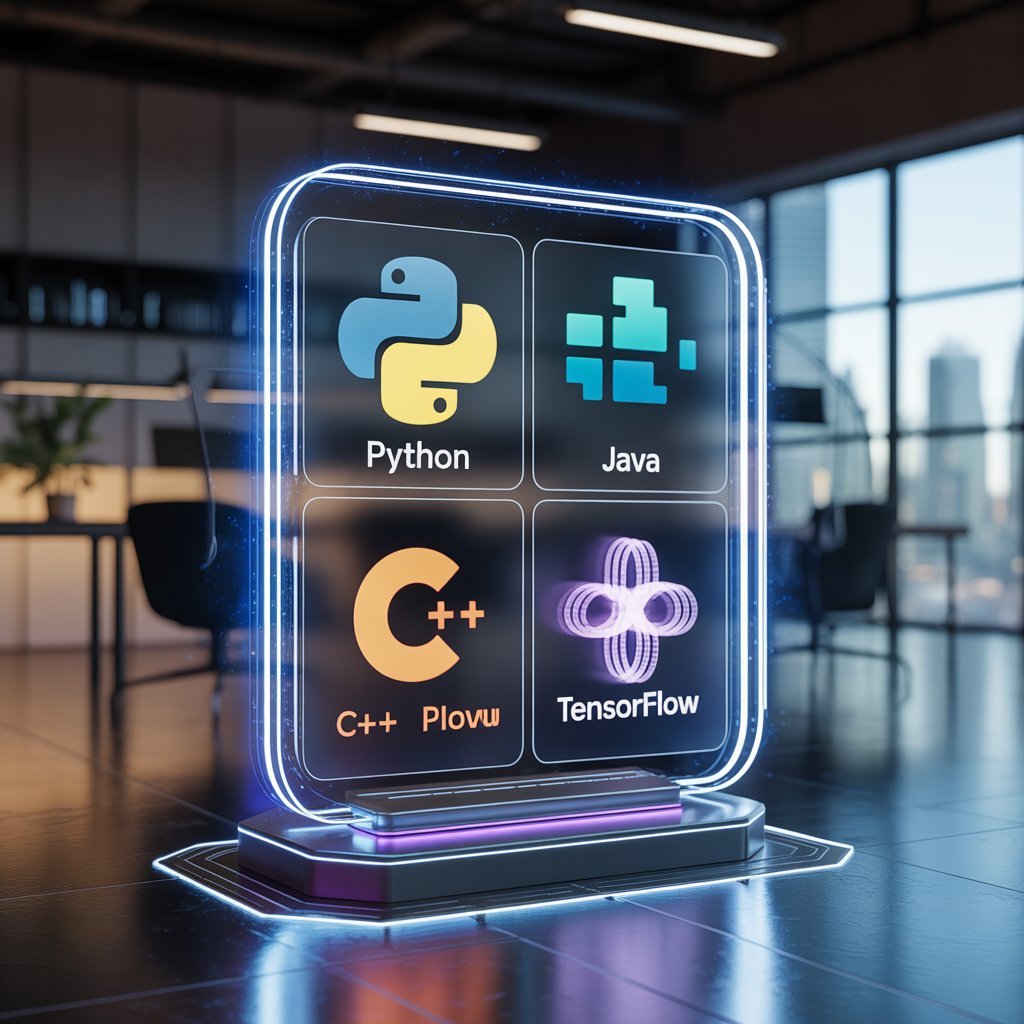
Comparing AI Programming Languages
When choosing a language, think about these factors:
- Ease of learning: Python and JavaScript are the easiest.
- Speed and performance: C++ and Julia are the fastest.
- Library support: Python has the richest libraries.
- Community help: Python and Java have the biggest communities.
- Best for beginners: Python.
- Best for professionals: C++ and Julia.
How to Choose the Right AI Language for You
- Based on your career goals:
If you want to work in research, learn Python or R.
Learn Java if you want a job in a large organization.
If you want to work on robotics or gaming, learn C++. - Based on your project needs:
Web-based AI → JavaScript.
For rapid computing, consider using Julia or C++. - Based on the learning curve:
Easy → Python.
Medium → Java.
Hard → C++.
The future of AI programming languages
The AI world is growing fast, and so are its languages.
- Growing in popularity: Python, Julia, and JavaScript.
- May decline: Prolog, Lisp (but still useful in research).
- Important to know multiple languages: As AI projects become more advanced, knowing more than one language will give you an edge.
Conclusion
AI is one of the fastest-growing fields, and learning the right programming language can open big opportunities. While Python is the best starting point, languages like R, Java, C++, Julia, JavaScript, Prolog, and Lisp all have their unique roles in AI development.
The best choice depends on your goals. Choose Python for a quick start. If you want to work in research, go for R or Julia. For enterprise AI, Java is a fantastic choice. For high-performance systems, pick C++.
At the end of the day, there is no “one best language.” Instead, the best language is the one that fits your project, career, and passion.
FAQs
1. What is the easiest language to start AI programming?
Python is the easiest and most beginner-friendly AI language.
2. Which AI programming language is best for beginners?
Python is the best choice for beginners due to its simple syntax and extensive AI libraries.
3. Is Python enough for AI development?
Yes, Python is enough to start with, but learning other languages will give you more flexibility.
4. Do I need to learn more than one AI programming language?
Initially, it is not necessary to learn more than one AI programming language. One language (like Python) is enough, but later, learning more can boost your career.
5. Which AI programming language has the highest demand in jobs?
Python is the most in-demand for AI jobs worldwide.
Read Next
If you enjoyed learning about blockchain, here are some other articles you might like:
Excellent guide! Python and R are indeed top choices for AI development due to their robust libraries and simplicity. Very insightful for beginners and pros alike.
Comments are closed.